
1. Purpose
PhysioVerse exists to accelerate innovation, interoperability, reproducibility, and standards development for organoid and body on a chip technology by providing a neutral, collaborative environment for:
- Datasets
- Metadata standards
- Software tools
- Reference implementations
- Validation frameworks
- Best practices
- Pre-standards development
- Industry and academic collaboration
PhysioVerse serves as a pre-competitive environment where stakeholders collaborate before technologies mature into formal standards. We are using a federated governance structure modeled after successful elements of the Linux Foundation, Eclipse Foundation, and scientific consortia. PhysioVerse is unique and creates long-lasting value through its data governance plus validation governance. Once datasets, metadata, models, and protocols have been rigorously validated they are suitable for eventual standards development. The governance of this open-source ecosystem will help guide this process along.
Why a Federated Model?
It is a way of organizing a community so that many independent groups can work together toward a common goal without giving control to a single organization.
Instead of one central organization making all decisions, responsibility is shared among different councils, committees, and participating organizations. Each group focuses on a specific area, such as data, standards, software, partnerships, or validation, while following a common set of rules and goals.
2. Guiding Principles
| Principle | Description |
|---|---|
| Openness | Technical specifications, governance processes, and decisions shall be publicly available. It allows for common rules and policies, with participants agree to shared principles, processes, and quality expectations. It has a collaborative decision making, with major decisions are made through representative councils and committees. |
| Neutrality | No single organization shall control the ecosystem due to shared leadership. Distributed responsibility with different groups oversee different functions. |
| Transparency | Governance activities, decisions, and voting records shall be documented and publicly accessible. |
| Scientific Rigor | All technical outputs shall be evidence-based and subject to peer review and validation. |
| Reproducibility | The ecosystem shall prioritize reproducible science and interoperable technologies. |
| FAIR Data | All data initiatives should support these principles: Findable, Accessible, Interoperable, Reusable. |
| Open Participation | Organizations can contribute data, software, expertise, standards, and resources. |
| Local Autonomy | Participants retain ownership of their own activities and resources while contributing to the larger ecosystem. |
3. Governance Framework
PhysioVerse shall operate through a federated governance structure that will use a distributed authority across multiple stakeholder groups while maintaining overall coordination through a central governing body. This form of governance was selected because it will balance the needs of the ecosystem which includes metadata and datasets, software, standards, validation programs, intellectual property management, industry partnerships, and regulatory engagement.
| Area | Content |
|---|---|
| Governing bodies | Governing Board /Board of Directors; Technical Steering Committee (TSC); Standards and Pre-Standards Council; Data Governance Council; Validation and Verification Committee; IP and Legal Committee; Scientific Advisory Board; Partnership and Ecosystem Council. |
PhysioVerse Core Principles
| Core Principle | Meaning |
|---|---|
| Shared Decision-Making | No single organization controls the ecosystem. |
| Domain Expertise | Decisions are made by the groups closest to the work. |
| Transparency | Governance processes, votes, and policies are openly documented. |
| Merit and Representation | Leadership reflects both expertise and stakeholder diversity. |
| Subsidiarity | Decisions are made at the lowest competent level. |
| Consensus First, Voting When Needed | Encourage collaboration before formal votes. |
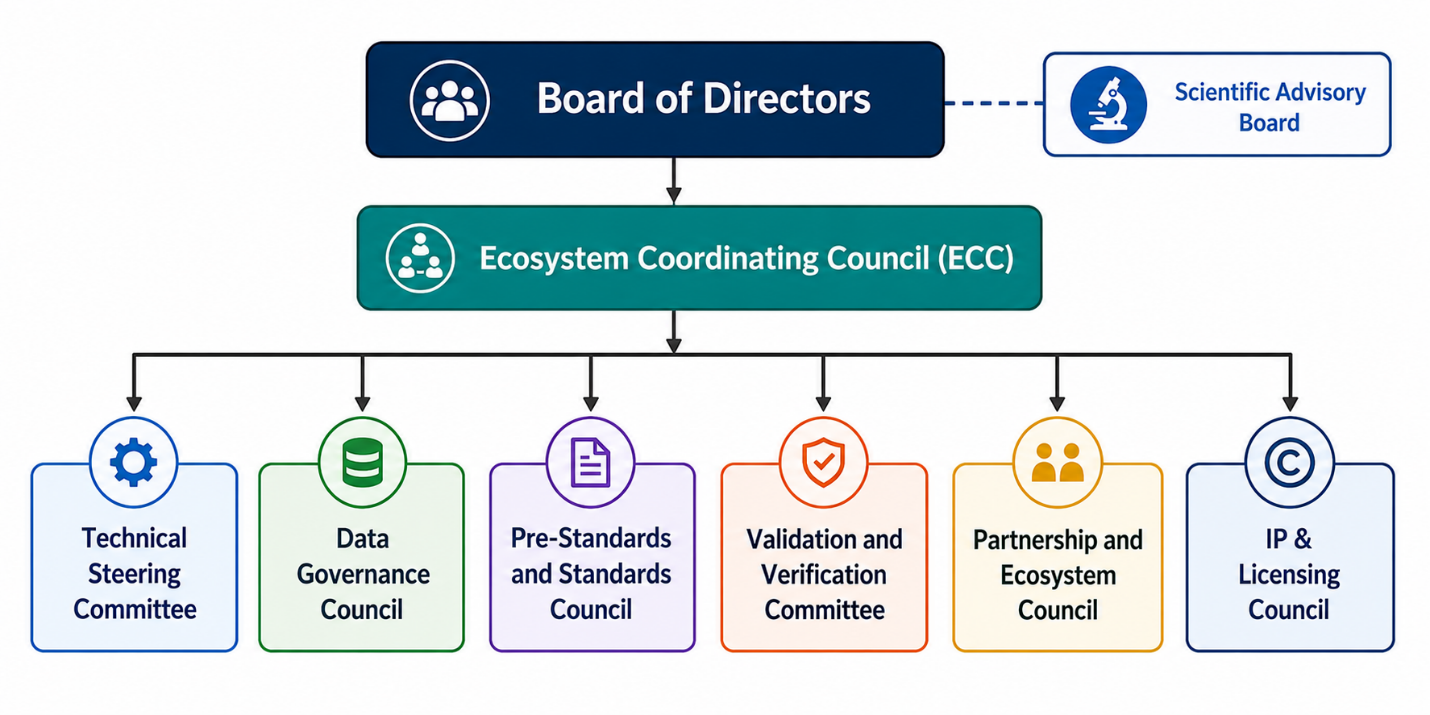
4. Governing Board /Board of Directors
Responsibilities
The Governing Board provides strategic oversight and fiduciary responsibility.
Authority
The Board shall approve budgets, approve strategic plans, approve membership structures, approve governance amendments, appoint committee chairs, approve major partnerships, elect a liaison to ensure continuity of pre-standards and standards efforts between the Standards Development Organization and PhysioVerse and will Chair the Standards and Pre-Standards Council, and authorize the Committee and Council Chairs to select committee/council members.
Composition of the Governance Board (11 voting members)
| Category | Seats |
|---|---|
| Industry | 4 |
| Academic | 3 |
| Nonprofit/Government | 2 |
| Independent Experts | 2 |
Voting
Major decisions require two-thirds approval and minimum quorum of 60%.
5. Technical Steering Committee (TSC)
Purpose
The TSC governs technical assets and will represent the participating organizations and be comprised of the expertise needed to govern technical assets while avoiding domination by any single stakeholder group. The Technical Manager will provide oversight of the TSC.
| Area | Content |
|---|---|
| Scope | Software projects; APIs; Data models; Metadata schemas; Reference implementations. |
| Responsibilities | Technical roadmap development, implementation, and oversight; Project lifecycle management for each project and product; Project approvals; Technical architecture review; Interoperability oversight. |
Composition of Technical Steering Committee
The TSC will be led by: Chair; Vice Chair; Secretary (non-voting, providing administrative support). There will be 13 TSC members, comprised of:
| Category | Seats | Members |
|---|---|---|
| Software and Infrastructure | 3 | Open-source platform lead; Data platform architect; AI/ML systems architect. |
| Data and Metadata | 3 | Data governance representative; Ontology expert; FAIR data expert. |
| Scientific Experts | 3 | Organoid researcher; Organ-on-chip researcher; Manufacturing expert. |
| Validation and Standards | 2 | Validation committee representative; Standards liaison representative. |
| Community Representatives | 2 | Elected contributor representative; Elected dataset contributor representative. |
Decision Making
Consensus preferred. If consensus cannot be reached by simple majority vote. Minimum quorum 60%.
6. Standards and Pre-Standards Council (PSSC)
Purpose
Develop candidate specifications prior to submission to standards development organizations. The PSSC bridges research, industry, validation, and formal standards organizations. Its role is not to create formal standards itself, but to determine when ecosystem outputs are mature enough to advance toward standards development.
| Area | Content |
|---|---|
| Responsibilities | Gap analysis; Draft specifications; Public comment processes; Reference implementation requirements; Standards readiness assessment. |
| Deliverables | Technical specifications; Implementation guides; Best practices; Candidate standards. |
| Exit Criteria | Before submission to an SDO, a specification must demonstrate: Two independent implementations; Validation evidence; Public review completion; Technical Steering Committee approval. |
Composition of the PSSC
The TSC will be led by: Chair; Vice Chair; Secretary (non-voting, providing administrative support). There will be 15 PSSC members, comprised of:
| Category | Seats | Members or experience |
|---|---|---|
| Standards Development Liaisons | 3 | Representatives must have working-knowledge of one or more of the following: ASTM International, ISO, and/or HL7 International. |
| Industry Representatives | 4 | Biopharma; Cell therapy company; Organ-on-chip technology provider; Instrumentation/data platform company. |
| Academic Representatives | 2 | Organoid expert; Tissue engineering expert. |
| Regulatory Science Representatives | 2 | Experts with experience in: Regulatory science; Validation science; Qualification pathways. Ideally, but not required, at least one representative should have international regulatory experience. |
| Technical Steering Committee Representatives | 2 | Software/interoperability lead; Architecture/data standards lead. |
| Validation Committee Representative | 1 | Benchmarking and conformance expert. |
| Community Representative | 1 | Elected contributor. |
Decision Making
Consensus preferred. If consensus cannot be reached by simple majority vote. Minimum quorum 60%.
7. Data Governance Council (DSG)
Purpose
Ensures quality, integrity, and stewardship of shared data which is foundational, and impacts data quality, metadata consistency, provenance, sharing policies, and trust.
| Area | Content |
|---|---|
| Responsibilities | Dataset acceptance criteria; Metadata standards; FAIR compliance; Data quality frameworks; Data lifecycle management. |
| Dataset Submission Requirements | Each dataset shall include: Data dictionary; Metadata package; Provenance documentation; Usage license; Quality statement. |
| Dataset Categories | To increase quality, completeness, maturity, validation status, and suitability for different uses, a tier or other classification grading system to indicate the quality of data provided. The Technical Manager will select the classification to be utilized. |
Composition of the DSG
The TSC will be led by: Chair; Vice Chair; Secretary (non-voting, providing administrative support). There will be 13 DSG members, comprised of:
| Category | Seats | Members or experience |
|---|---|---|
| Data Producers | 3 | Represent organizations generating: Organoid datasets; Organ-on-chip datasets; Manufacturing datasets. |
| Data Users | 2 | Represent: Researchers; AI/ML developers; Model developers. |
| Metadata & Ontology Experts | 2 | Experts in: Controlled vocabularies; Ontologies; Semantic standards. |
| Bioinformatics/Data Science Experts | 2 | Experts in: Data architecture; Data integration; Machine learning readiness. |
| Validation Representatives | 2 | Nominated by the Validation and Verification Committee with responsibilities: Data quality metrics; Benchmark dataset review; Reproducibility requirements. |
| Regulatory/Data Quality Representative | 1 | Experience in: Quality systems; Evidence generation; Data traceability. |
| Community Representative | 1 | Elected by contributors. |
Decision Making
Consensus preferred. If consensus cannot be reached by simple majority vote. Minimum quorum 60%.
DSG Subcommittees
The DSG has the authority to establish subcommittees. Each Subcommittee will have a Chair and Vice Chair, with non-voting Secretary. The committee to be established include, but not limited to the following topics areas:
| Subcommittee | Size | Responsibilities and deliverables |
|---|---|---|
| Metadata & Ontology Subcommittee | 5 to 7 voting members | Responsible for: Metadata schemas; Controlled vocabularies; Ontology mappings. |
| Data Quality Subcommittee | 5 to 7 voting members | Responsible for: Quality metrics; Completeness assessments; Provenance requirements. |
| FAIR & Interoperability Subcommittee | 7 to 9 voting members | Responsible for: FAIR assessments; API compatibility; Data exchange specifications. This committee will be responsible for the following deliverables and presenting on a regular basis to the Governance Board: FAIR compliance reports; Interoperability profiles. Materials generated by this committee will be posted for the community to access within 60 days of completion on the PhysioVerse Portal. |
| Data Access & Ethics Subcommittee | 5 to 7 voting members | Responsible for: Access policies; Sharing agreements; Responsible use guidelines. Deliverables: Access framework; Data usage policies. |
Each subcommittee is permitted to allow non-voting observers from the community to attend, and the observers may participate in the discussions but are not permitted to vote.
There will be a liaison from each of the following committees. These liaisons will assist in coordinating governance across the ecosystem, and provide a report on the discussions and actions to their respective committees: Technical Steering Committee; Standards Council; Validation Committee.
8. Validation and Verification Committee (5 to 7 voting members)
| Area | Content |
|---|---|
| Purpose | Establish confidence in ecosystem outputs. The Committee will establish validation levels and other criteria as appropriate. |
| Scope of Committee Validation | Datasets; Metadata; Software; Models; Protocols; Specifications. |
| Responsibilities | Benchmark development; Round-robin testing; Reproducibility assessments; Validation scorecards. |
9. Intellectual Property and Legal Committee (5 to 9 voting members)
| Area | Content |
|---|---|
| Purpose | Manage intellectual property and licensing. The Committee establishes and maintains the legal, intellectual property, licensing, compliance, and risk-management frameworks that enable open collaboration, standards development, software innovation, dataset sharing, and ecosystem sustainability. |
| Responsibilities | Contributor agreements; Licensing strategy; Patent disclosure review; Open standards policy. |
| Composition of Committee | IP attorney; Open-source licensing expert; Data privacy expert; Industry legal representative; Academic technology transfer representative; Standards/legal specialist; Regulatory affairs representative; Ethics advisor (optional). |
Licensing Principles
| Principle | Content |
|---|---|
| Software | Preferred licenses: Apache 2.0; MIT; BSD. |
| Data | Preferred licenses: CC-BY; CC0; Open Data Commons. |
| Standards | This committee will support the efforts of the Pre-standards and Standards Council. Specifications shall be published under royalty-free terms whenever possible. The Standards Development Organization will have oversight responsibility development of standards. |
| Patent Disclosure | Contributors must disclose known essential patents relevant to contributed specifications. |
| Membership Participation Agreements | Develops the legal framework for participation. |
| Risk Compliance and Management | Working with the various committees. Councils, and Board of Director, this committee will help to identify and mitigate ecosystem risks. |
10. Scientific Advisory Board
Purpose
Provide scientific guidance and credibility. The Board serves as an independent scientific authority to the Board of Directors, and provides strategic guidance, ensures scientific rigor, and helps align ecosystem activities with emerging research, industry needs, and regulatory expectations.
Unlike the Technical Steering Committee, Data Governance Council, or Pre-Standards and Standards Council, the Scientific Advisory Board is generally advisory rather than operational. It does not manage projects directly but provides expert oversight and recommendations to the Board of Directors and Ecosystem Coordinating Council. They are nonvoting observers on committees and councils. The Advisory Board may make recommendations but not mandate actions.
Members are appointed by the Board through nominations from the various councils, committees, Board members, or community, and with a simple majority approval required.
| Area | Content |
|---|---|
| Responsibilities | Technology horizon scanning; Emerging science assessment; Research priorities; Regulatory science guidance. |
11. Partnership and Ecosystem Council
| Area | Content |
|---|---|
| Purpose | Promote ecosystem growth and stakeholder engagement. The Partnership and Ecosystem Council develops and manages strategic relationships, community engagement, membership growth, and collaborative initiatives that expand the ecosystem's impact, sustainability, and adoption. |
| Responsibilities | Recruitment; Strategic partnerships; International collaboration; Education and outreach. |
| Stakeholder Categories Will Actively Recruit | Academia; Industry; Government; Nonprofits; Patient organizations; Standards organizations. |
12. Working Groups
Working Groups are responsible for technical execution and are established as the discretion of the various committees, councils, and the Board of Directors.
| Area | Content |
|---|---|
| Examples | Organoids; Organ-on-Chip; Cell Manufacturing; AI and Machine Learning; Data and Metadata; Regulatory Science; Validation Methods; Interoperability. |
| Formation | A Working Group may be established when: Minimum of five participating organizations; Approved charter, renewed annually; Approved chair of the Working Group; Established by a Committee or Council to address specific tasks. |
13. Membership
| Member Type | Participation |
|---|---|
| General Members | May participate in: Working groups; Public reviews; Community activities. |
| Contributing Members | May: Vote in Working Groups; Submit projects; Hold committee positions. |
| Strategic Members | May: Hold Governing Board seats; Sponsor ecosystem initiatives. |
14. Decision-Making Framework
| Decision Type | Authority |
|---|---|
| Budget | Governing Board |
| Governance Changes | Governing Board |
| Technical Roadmaps | TSC |
| Dataset Approval | Data Governance Council |
| Validation Approval | Validation Committee |
| Standards Readiness | Standards Council |
| Licensing Policies | IP Committee |
15. Conflict of Interest Policy
Purpose of this policy is to:
- Protect the integrity of ecosystem decisions
- Promote transparency and accountability
- Ensure decisions are made in the best interests of the ecosystem
- Prevent undue influence by individuals or organizations
- Maintain stakeholder confidence
Definition of Conflict of Interest
A conflict of interest exists when an individual's personal, professional, financial, organizational, or institutional interests could influence-or appear to influence-their judgment or decision-making on behalf of the ecosystem.
Both actual conflicts and perceived conflicts must be disclosed. Members with material conflicts shall recuse themselves from related votes.
All leaders shall disclose annually to the legal committee per SOP:
- Financial interests
- Employment affiliations
- Patent ownership, Licensing, and other conflicts
- Consulting relationships
- Organization conflicts, including membership on other Board or scientific advisory board scientific conflicts
- Equity Interest
16. Transparency Requirements
The ecosystem shall publicly maintain:
- Governance documents
- Meeting minutes
- Voting records
- Technical roadmaps
- Validation reports
- Approved specifications
Confidential information may be protected only when legally required and must be declared in writing on any materials considered confidential. The Legal Committee will establish policies and procedures regarding handling confidential materials.
17. Maturity Model
The Technical Manager, Technical Steering Committee, and affiliated Working Groups will use the following stages to indicate progression of a project. The Technical Manager will develop additional criteria for each stage of maturity, submitted to the Technical Steering Committee for approval. Projects shall progress through the following stages (and how they are defined):
| Stage | Definition |
|---|---|
| Stage 1 - Proposal | Concept submitted |
| Stage 2 - Incubation | Initial development |
| Stage 3 - Community Review | Multi-stakeholder review |
| Stage 4 - Validation | Independent testing completed |
| Stage 5 - Reference Implementation | Multiple implementations available |
| Stage 6 - Pre-Standard | Ready for standards consideration |
| Stage 7 - Standards Submission | Transferred to the standards development organization |
18. Relationship with Standards Development Organizations
PhysioVerse is not a formal standards body. Its role is to:
- Incubate ideas
- Validate concepts
- Produce reference implementations
- Generate evidence
Formal standards development remains the responsibility of recognized standards organizations. This separation preserves neutrality while allowing the ecosystem to function as a high-value pre-standards validation and innovation environment.